


Why Repetition Feels Boring — But Is Actually the Key to Fluency
If you’ve ever felt like you’re seeing the same Spanish words and phrases over and over again, you’re not wrong.
Repetition is everywhere in language learning—and at first, it can feel frustrating. You might think, “I already saw this… shouldn’t I be moving on?”
But here’s the truth: repetition isn’t slowing you down. It’s the reason fluency becomes possible.
The key is not avoiding repetition—it’s experiencing it in a way that feels natural, not forced.
Why Repetition Is Necessary to Learn Spanish
Learning a language isn’t about seeing something once and remembering it forever. It’s about encountering the same structures enough times that they become familiar.
Your brain needs multiple exposures to truly recognize and retain new words and patterns.
Think about how often you’ve seen a word before it finally “clicked.” It wasn’t the first time—or even the second. It was after repeated exposure, in slightly different contexts, that it started to feel natural.
This is especially true when you’re learning through spanish audio stories
When you hear the same types of sentences again and again, your brain begins to anticipate meaning. You start recognizing patterns without needing to translate everything.
That’s when comprehension starts to build.
Why Repetition Feels So Boring (At First)
The problem isn’t repetition itself—it’s how it’s usually presented.
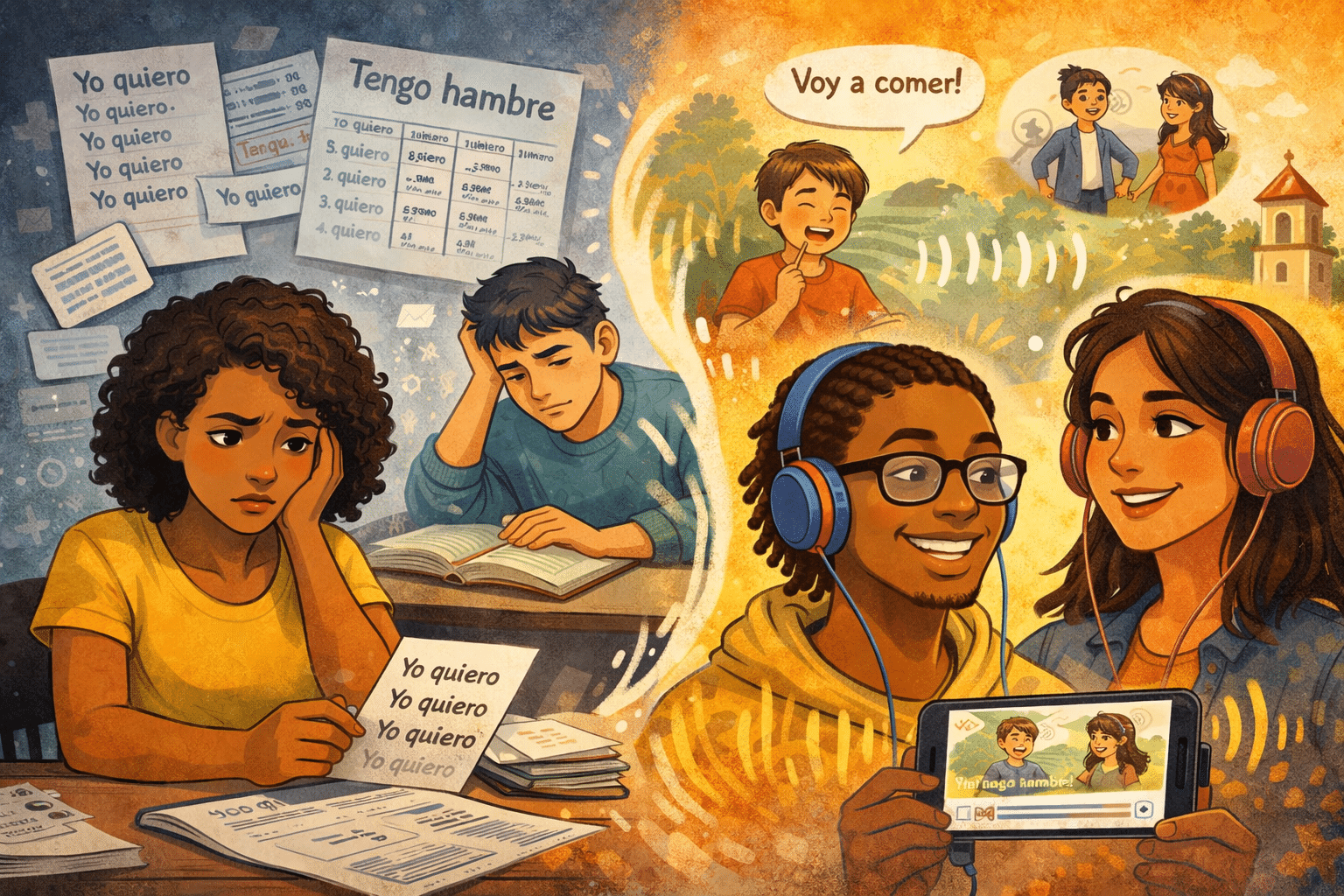
Traditional methods often rely on drills, flashcards, or isolated sentences. These can feel repetitive in a mechanical way, without any emotional connection or sense of progress.
You’re repeating—but you’re not experiencing anything.
That’s why it feels tedious.
Your brain craves meaning, context, and movement. Without those, repetition becomes something you have to push through instead of something that naturally holds your attention.
How Stories Turn Repetition Into Something You Enjoy
Stories change the experience completely.
Instead of repeating random sentences, you’re following a narrative. You’re seeing characters interact, make decisions, and move through situations.
And within that story, repetition happens naturally.
You’ll see similar phrases, sentence structures, and vocabulary appear again and again—but each time, they’re tied to a slightly different moment.
That makes a big difference.
With bilingual spanish english stories, repetition doesn’t feel like a task. It feels like part of the story unfolding.
You’re not thinking, “I’ve seen this before.”
You’re thinking, “Oh, I understand this more clearly now.”
Why Spanish Audio Stories Strengthen Repetition Even More
Reading repetition is powerful. Hearing it adds another layer.
When you listen to spanish audio stories, you’re reinforcing the same patterns through sound, rhythm, and pronunciation.
You start to recognize not just what the words mean, but how they flow together.
This matters because fluency isn’t just about understanding—it’s about processing language in real time.
Hearing repeated structures helps your brain get faster at recognizing them. You don’t need to pause or analyze as much, because the patterns are becoming familiar through exposure.
Over time, this creates a sense of ease.
Familiarity Builds Confidence (Even If You Don’t Notice It)
One of the most overlooked benefits of repetition is confidence.
When something feels familiar, it stops feeling intimidating.
You begin to trust that you can understand what you’re reading or hearing—even if you don’t catch every single word.
This is where repetition quietly does its best work.
You’re no longer starting from zero each time. You’re building on what you’ve already seen, already heard, already processed.
Platforms like Dual Language Stories are designed around this idea—using bilingual Spanish English stories and audio to create repeated exposure within a meaningful context.
You’re not reviewing the same list of words.
You’re revisiting patterns as part of a larger experience.
Why You Don’t Need to Force Repetition
A lot of learners try to force repetition—reviewing the same material over and over because they feel like they should.
But repetition works best when it happens naturally.
Stories create that environment.
As you move through different stories, similar structures appear again—not in an identical way, but in a way that feels connected and relevant.
This kind of repetition doesn’t feel like going backwards.
It feels like moving forward with more clarity each time.
If you want a simple way to experience this, starting with a small set of stories—like a free pack—can help you notice how repetition builds understanding over time without feeling repetitive.
Final Thoughts
Repetition might feel boring on the surface, but it’s one of the most important parts of learning Spanish.
The difference is in how you experience it.
When repetition is tied to stories, audio, and real meaning, it stops feeling like something you have to endure—and starts becoming something that naturally builds fluency.
So instead of trying to avoid repetition, lean into it.
Not through drills or memorization, but through consistent exposure to stories that make the language feel alive.
That’s where real progress happens.



Comments (0)
DejarUn Comentario