


How Stories Quietly Teach Grammar Without You Noticing
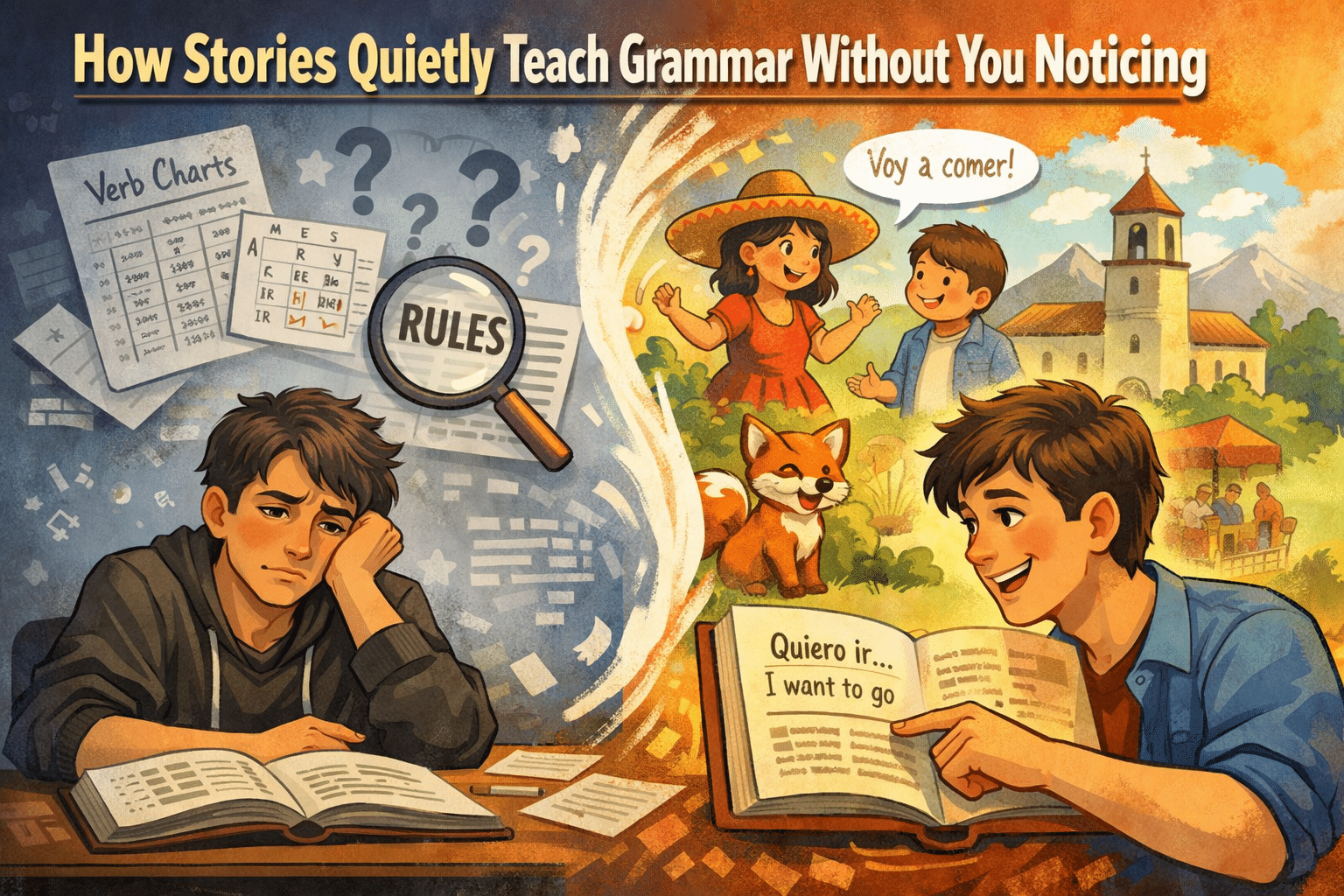
If you’ve ever tried to learn Spanish through traditional methods, you’ve probably spent time memorizing verb charts, grammar rules, and exceptions that seem to multiply the more you study.
And yet, when it’s time to actually understand or speak the language, everything still feels… out of reach.
That’s because grammar doesn’t truly “stick” when it’s learned in isolation. It starts to make sense when you experience it in context—over and over again—without forcing yourself to memorize every rule. This is exactly where stories come in.
Why Learning Spanish Through Stories Feels More Natural
When you learn Spanish through stories, you’re not focusing on grammar rules—you’re focusing on meaning.
You’re following a character. You’re understanding what’s happening. You’re picking up on emotions, actions, and small details that make the language feel alive.
And while that’s happening, something important is taking place in the background: your brain is recognizing patterns.
Instead of studying verb conjugations in a chart, you start seeing how verbs actually behave in real sentences. Instead of memorizing when to use certain structures, you begin to feel what sounds right.
This is the difference between learning about a language and becoming familiar with it.
How Grammar Patterns Start to Appear on Their Own
When you read bilingual Spanish English stories, you’re exposed to the same structures repeatedly—but in slightly different ways each time.
You might notice phrases like:
- “Quiero ir” (I want to go)
- “Necesito hablar” (I need to speak)
- “Voy a comer” (I’m going to eat)
At first, these are just phrases you recognize.
But after seeing them again and again across different stories, something shifts. You begin to understand how verbs connect. You start to recognize how meaning is built.
No one sat you down and explained the rule.
You just saw it enough times that it became familiar.
That’s how real language acquisition works—through exposure, not memorization.
Why Bilingual Spanish English Stories Make This Even Easier
Adding English alongside Spanish doesn’t slow you down—it actually speeds up understanding.
With bilingual Spanish English stories, you don’t have to stop every few seconds to translate or guess what something means. You can stay inside the flow of the story while still clearly understanding what’s happening.
This matters because comprehension is what allows patterns to stick.
When you understand the meaning of a sentence, your brain can focus on how that meaning is constructed. Over time, you begin to connect the structure of Spanish with the ideas you already understand in English.
Instead of feeling lost, you feel grounded—and that makes repetition far more effective.
Listening Reinforces What You Read
Reading helps you see patterns. Listening helps you absorb them.
When you combine stories with audio, you’re hearing how the language actually sounds in real time—how sentences flow, how verbs are used naturally, and how rhythm and pronunciation come together.
This adds another layer of familiarity.
You’re not just recognizing grammar visually—you’re hearing it repeatedly in context.
Over time, this makes the language feel more intuitive. You don’t need to pause and analyze every sentence, because your brain has already started to internalize the structure through exposure.
Why This Works Better Than Memorizing Rules
Memorizing grammar rules can feel productive in the moment, but it often creates a disconnect between knowledge and usage.
You might know the rule—but that doesn’t mean you can apply it quickly or naturally.
Stories solve this problem by giving you repeated, meaningful exposure.
Instead of asking, “What’s the rule here?” your brain starts asking, “What sounds right?”—and answering it correctly more often over time.
This is the same way you learned your first language.
Not through charts. Not through memorization.
Through patterns, repetition, and context.
A More Sustainable Way to Build Confidence
One of the biggest challenges for adult learners is consistency. If a method feels heavy or frustrating, it’s hard to stick with it long enough to see results.
Stories change that.
They give you a reason to come back—not because you “should,” but because you want to see what happens next.
Platforms like Dual Language Stories focus on this approach by combining bilingual Spanish English stories with audio, making it easier to stay engaged while building real understanding over time.
You’re not forcing grammar into your brain.
You’re letting it build naturally through experience.
Final Thoughts
Grammar doesn’t have to be something you struggle through or memorize piece by piece.
When you learn Spanish through stories, you begin to absorb structure the way it’s actually used—through repetition, context, and meaningful exposure.
Over time, what once felt confusing starts to feel familiar.
And that’s when real progress begins.
Not when you’ve memorized every rule—but when the language starts to make sense on its own.




Comments (0)
DejarUn Comentario