


Why Podcasts Feel Hard — But Story Audio Doesn’t
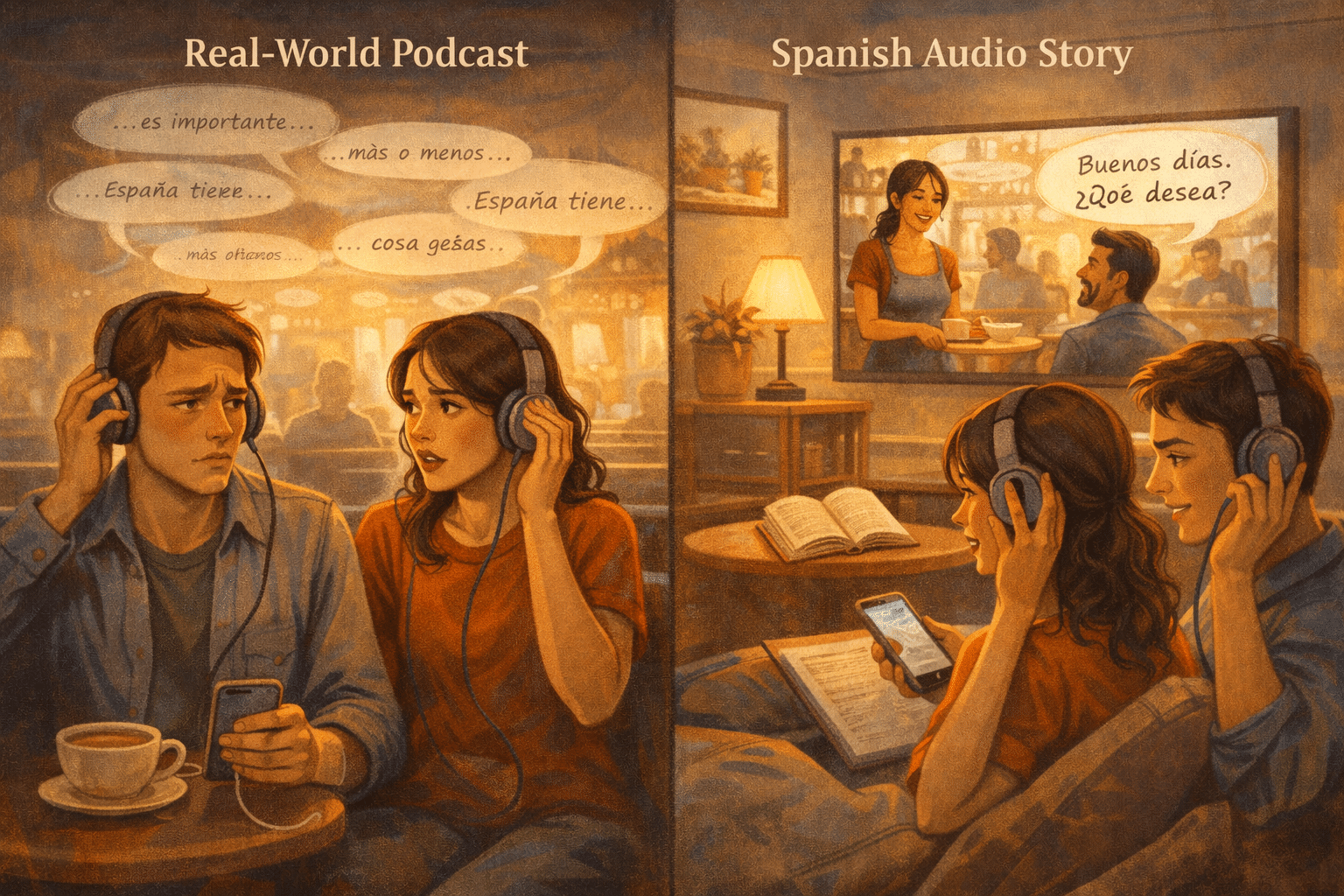
If you’ve ever tried to learn Spanish by listening to audio, you may have started with podcasts. It seems like the logical choice. Podcasts are everywhere, they’re easy to access, and many learners assume that listening regularly will naturally improve comprehension.
But after a few minutes, something frustrating happens.
You catch a few words. Maybe a sentence here and there. Then the speaker moves on, and suddenly the conversation feels like a blur of sound. Even when the topic is interesting, it becomes exhausting to follow.
This experience is incredibly common. It’s not a sign that you’re bad at languages. It’s simply a mismatch between the type of audio you’re using and the stage of learning you’re in.
That’s why many learners discover that spanish audio stories feel dramatically easier than podcasts.
The difference comes down to structure.
Why Random Listening Overwhelms the Brain
Podcasts, radio shows, and casual conversations are designed for native speakers. They assume the listener already understands vocabulary, pronunciation patterns, and the rhythm of the language.
When you listen to this type of audio as a learner, your brain is forced to do several difficult things at once:
- Recognize unfamiliar words
- Process grammar in real time
- Understand the topic
- Keep up with the speed of the speaker
Without enough context, your brain struggles to predict what’s coming next. Every sentence feels like a new puzzle.
This is why many learners say they feel tired after just a few minutes of listening practice. It’s not a lack of effort — it’s cognitive overload.
Traditional audio Spanish lessons sometimes have a similar problem. They may slow down the language or isolate vocabulary, but they still lack a natural flow that keeps your brain engaged.
Story audio solves this problem in a different way.
Why Story-Based Audio Feels Easier
When you listen to a story, your brain is not just processing language — it’s following a narrative.
That narrative provides context.
If a character is ordering food in a café, your brain expects certain vocabulary to appear. If the story takes place at a train station, certain phrases become easier to recognize.
In other words, the story helps your brain predict meaning.
This predictive ability dramatically reduces listening stress. Instead of decoding every word individually, you understand the scene and fill in gaps naturally.
That’s why spanish audio stories often feel more accessible than random listening material. The narrative creates a framework that supports comprehension.
You’re not just listening to Spanish. You’re following something.
Why Stories Support Listening Growth
Another advantage of story audio is repetition.
In everyday conversation, topics change quickly. In a story, themes and vocabulary repeat in meaningful ways. Characters reappear. Situations build on each other. Familiar phrases return.
This repetition allows your brain to gradually recognize patterns.
At first, you might only understand fragments. After listening again, those fragments start to connect. Soon entire sentences become recognizable.
This process is exactly what learners need when they are trying to learn Spanish by listening to audio.
The goal is not to understand everything immediately. The goal is to build familiarity over time.
Stories make that process natural.
Listening Without Pressure
One of the biggest challenges in language learning is psychological. When learners press play on a podcast, they often feel pressure to keep up.
If they miss something, they assume they’ve fallen behind.
Story audio removes much of that pressure. Because the narrative unfolds gradually, it’s easier to stay relaxed while listening. Even if you miss a word or two, the overall meaning continues to develop.
That relaxed listening state is extremely important.
When your brain is calm, it processes language more effectively. Instead of struggling to decode every sound, it begins recognizing patterns automatically.
Over time, listening becomes less intimidating.
How Stories Fit into a Simple Learning Routine
For many learners, the most effective listening routine is surprisingly simple:
- Listen to a short story once for general understanding
- Listen again while paying attention to key phrases
- Return to the story later to reinforce what you heard
Because the narrative remains familiar, each repetition becomes easier.
If you want to see examples of this type of listening practice, explore Spanish story-based audio lessons designed for learners.
Many learners also like to start with shorter material before committing to longer content. You can try that approach with a small collection of beginner-friendly audio stories, Free 4-Story Pack.
Instead of overwhelming the listener, the story guides them forward.
Final Thoughts
Podcasts can eventually become a valuable tool for language learners. But for many people, they’re simply too difficult in the early stages of listening development.
If you’ve struggled with podcast-style listening, it doesn’t mean you’re failing. It just means you need more structure.
Spanish audio stories provide that structure.
They offer context, repetition, and a narrative that helps your brain anticipate meaning. Instead of fighting to keep up with random conversations, you’re following a story that gradually makes the language clearer.
And when listening starts to feel natural instead of stressful, real progress begins.



Comments (0)
DejarUn Comentario