



The Myth of Needing Grammar First to Learn Spanish
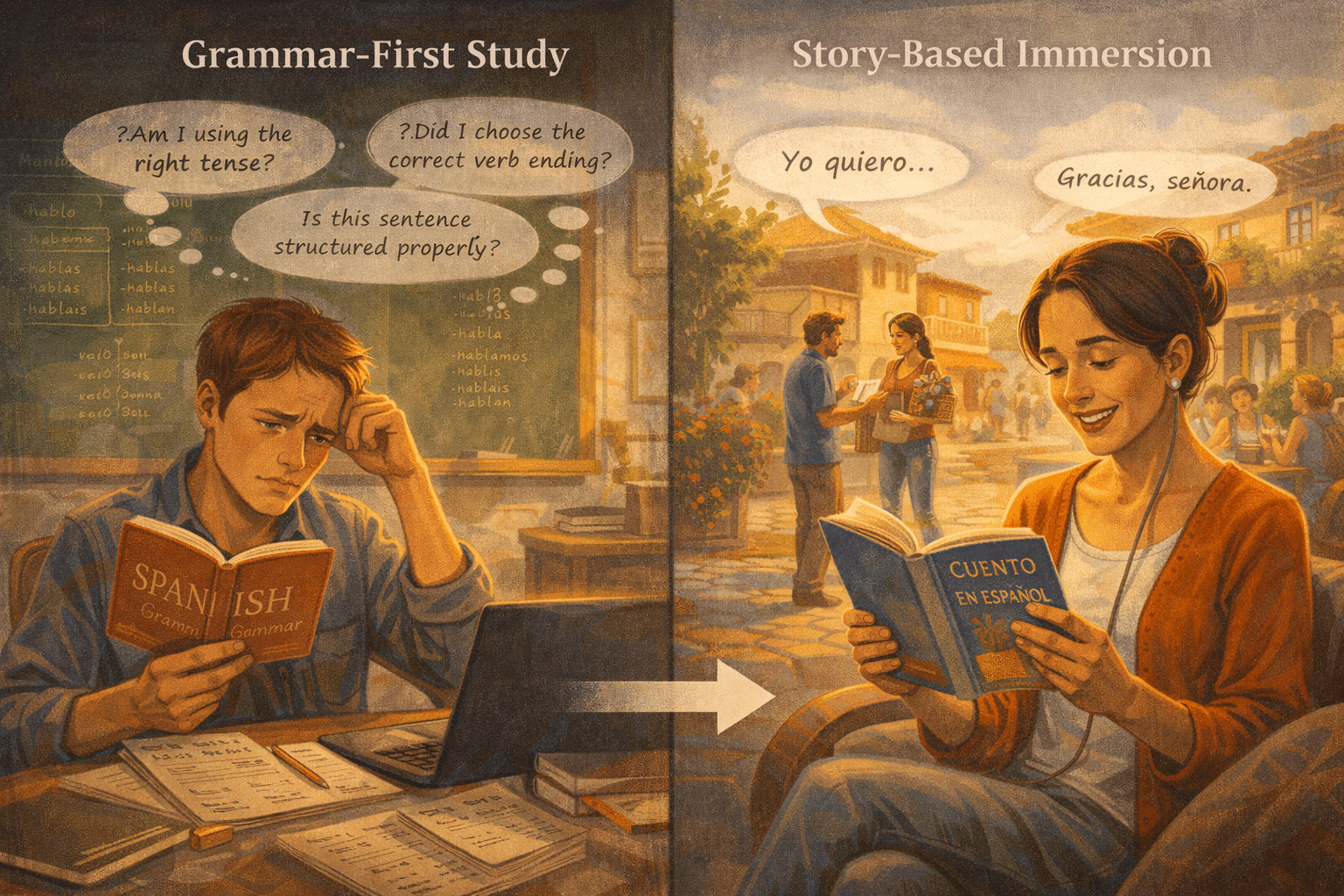
Many people begin learning Spanish with the same assumption: before you can really understand the language, you need to master the grammar.
Textbooks reinforce this idea. Traditional classes often start with verb charts, sentence structures, and detailed explanations of rules. The message is clear — grammar must come first.
But for many learners, this approach creates more frustration than progress.
You memorize rules, practice exercises, and study vocabulary lists, yet when you encounter real Spanish in conversation, movies, or reading, the language still feels difficult to follow.
The problem isn’t that grammar is unimportant. Grammar matters. The problem is the belief that it must be fully understood before you can start using the language naturally.
In reality, the best way to learn Spanish often looks very different from the traditional classroom model.
How Languages Are Actually Absorbed
Think about how people naturally acquire their first language.
Children don’t begin by studying grammar rules. They listen. They observe. They encounter words and patterns repeatedly in meaningful situations.
Over time, their brains begin to recognize those patterns automatically.
Grammar emerges gradually through exposure.
The same principle applies when adults learn a new language. While adults have the ability to analyze grammar consciously, that doesn’t mean analysis is the most effective starting point.
In many cases, heavy grammar study can slow down learning because it shifts focus away from meaning and toward rules.
When learners focus on understanding messages instead of memorizing structures, the brain begins organizing those patterns naturally.
Why Grammar-First Methods Often Feel Difficult
Traditional Spanish lessons online often follow a grammar-first structure.
A typical lesson might look like this:
First, a rule is explained.
Next, a set of example sentences appears.
Finally, the learner completes exercises designed to practice that rule.
While this structure can be helpful in some situations, it can also create a disconnect between studying Spanish and actually experiencing the language.
Instead of focusing on communication, the learner is constantly thinking about correctness.
Questions like these become common:
Am I using the right tense?
Did I choose the correct verb ending?
Is this sentence structured properly?
This constant analysis can make the language feel complicated and intimidating.
For many learners, it also removes the sense of enjoyment that originally motivated them to start.
Why Stories Provide a More Natural Learning Path
A different approach begins with exposure instead of explanation.
When learners read and listen to stories, they encounter grammar in context. Instead of studying rules in isolation, they see how sentences work within a meaningful situation.
This context makes patterns easier to recognize.
For example, when the same verb structures appear repeatedly in conversations between characters, your brain begins noticing how those structures function.
You don’t have to memorize them explicitly. Familiarity builds naturally.
This is one reason many learners find that they can learn Spanish through stories more comfortably than through rule-based exercises.
Meaning Before Rules
When you follow a story, your primary goal is understanding what is happening.
Who are the characters?
Where are they going?
What problem are they facing?
Because the focus stays on meaning, the language becomes easier to process.
As you encounter similar phrases and sentence patterns again and again, your brain gradually internalizes the grammar behind them.
Later, if you decide to study grammar more directly, those explanations suddenly make much more sense. The patterns are already familiar.
Grammar becomes clarification rather than the starting point.
Why This Approach Feels Less Stressful
Another advantage of learning through stories is that it removes the pressure to be perfect.
Instead of worrying about every small detail, learners can focus on understanding the overall message.
This relaxed mindset improves retention.
When the brain feels less pressure, it processes language more efficiently. Words and structures begin to feel familiar rather than confusing.
Over time, comprehension grows naturally, and confidence grows with it.
Where to Start
For many learners, the most effective starting point is exposure to clear, structured Spanish content that tells a story.
Narrative-based learning gives the brain context, repetition, and meaning — the ingredients that allow grammar to develop organically.
If you’d like to see examples of this approach, you can explore story-based Spanish learning designed around narrative exposure.
You can also learn more about the broader philosophy behind this method and how stories help learners absorb grammar naturally by visiting the main learning approach explained on the website..
Final Thoughts
Grammar is an important part of Spanish, but it doesn’t need to come first.
For many learners, the most effective path begins with understanding messages, following stories, and encountering the language in meaningful situations.
When grammar appears repeatedly in context, it becomes easier to recognize and remember.
That’s why many learners discover that the best way to learn Spanish isn’t by memorizing rules first — it’s by experiencing the language through stories, conversations, and real communication.
Over time, the grammar takes care of itself.




Comments (0)
DejarUn Comentario