


The Confidence Gap: Why You Understand More Spanish Than You Think

At some point in your learning, you’ve probably thought:
“I’m not really understanding this.”
“I’m still a beginner.”
“I should be further along by now.”
But then something unexpected happens.
You catch a sentence you didn’t expect to understand. You recognize a phrase without translating it. You follow part of a conversation more easily than before.
And yet… it still doesn’t feel like progress.
This is what many learners experience: a gap between what they actually understand and what they think they understand.
Why Your Brain Downplays Your Progress
When you’re learning Spanish, your brain tends to focus on what you don’t know.
If you understand 70% of a sentence, your attention goes straight to the missing 30%.
That creates the feeling of confusion—even when most of the message is clear.
But comprehension doesn’t work in an all-or-nothing way.
You don’t need to understand every word to understand meaning. In fact, most real-world language use relies on partial understanding, context, and familiarity.
The problem is that learners often measure progress by perfection.
And that makes real progress harder to see.
The Difference Between Recognition and Confidence
There’s a big difference between recognizing something and feeling confident about it.
You might recognize:
- Common verbs
- Familiar sentence structures
- Repeated phrases
But if you’re not consciously aware of it, you’ll assume you’re still struggling.
This is especially true when you learn Spanish through stories.
Stories expose you to patterns again and again—but in a natural, flowing way. You’re not stopping to label what you understand. You’re just following along.
As a result, your comprehension improves quietly.
But your confidence doesn’t always keep up.
Why Stories Reveal What You Already Know
One of the most powerful things about using spanish stories for adults is that they show you your progress in real time.
Instead of isolated sentences, you’re working with full scenes, actions, and conversations.
That gives your brain more context to work with.
Even if you don’t understand every word, you can often:
- Follow what’s happening
- Understand the intention of a sentence
- Predict what might come next
These are signs of real comprehension.
And they’re much more important than knowing every definition.
Stories make this visible because they create a continuous experience. You’re not starting and stopping—you’re moving forward, and your understanding builds as you go.
Why Listening Strengthens This Effect
When you combine reading with audio, the gap between comprehension and confidence starts to close.
Hearing the language reinforces what you already recognize visually.
You begin to notice:
- How familiar phrases sound in real time
- How quickly you can process meaning
- How often you understand more than you expected
This builds trust in your ability.
Instead of second-guessing yourself, you start to feel that understanding is happening—even if it’s not perfect.
You Don’t Need 100% Understanding to Be Improving
One of the biggest shifts for learners is realizing that progress doesn’t require full comprehension.
You don’t need to understand everything.
You need to understand enough—and keep exposing yourself to the language.
Over time, that “enough” becomes more and more.
When you consistently learn Spanish through stories, your brain fills in gaps through repetition and context.
What once felt unclear starts to feel familiar.
And what once required effort starts to feel automatic.
A More Accurate Way to Measure Progress
Instead of asking, “Did I understand everything?” try asking:
- Did I understand more than last time?
- Did parts of this feel familiar?
- Could I follow the general meaning?
These are better indicators of real growth.
Platforms like Dual Language Stories are designed to support this kind of progress, using Spanish stories for adults that allow you to experience the language in context rather than analyze it piece by piece.
You’re not being tested.
You’re being exposed to patterns in a way that gradually builds understanding.
Final Thoughts
The gap between your actual comprehension and your confidence is normal.
In fact, it’s part of the process.
You are likely understanding more than you think—you just haven’t fully recognized it yet.
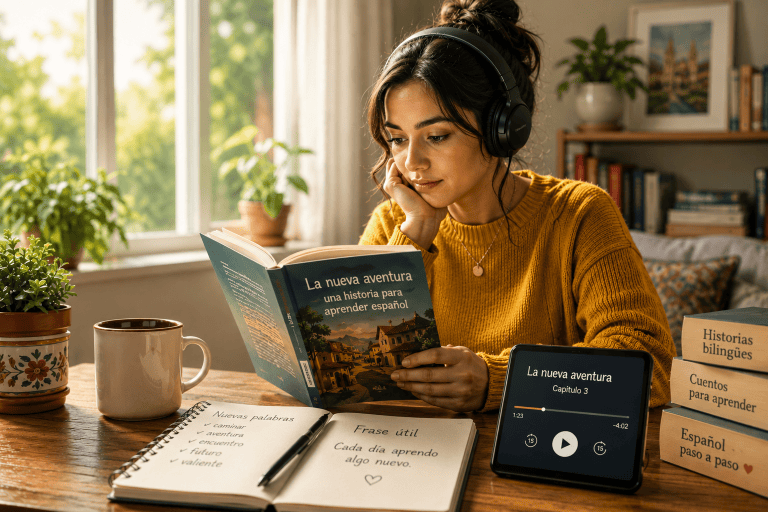
By continuing to read and listen to Spanish in a natural, story-based way, that gap starts to close.
Not all at once.
But steadily, quietly, and in a way that feels real.
And one day, you’ll notice that what once felt difficult now feels familiar—and your confidence will finally catch up to your ability.



Comments (0)
DejarUn Comentario