


Spanish Idioms and Bilingual Stories
Languages operate in strange ways. Meaning structures are ambiguous. And some of the best parts about these meaning structures are idioms and metaphors! Popularised through use, these catchy phrases have been passed down through generations. When you change the language, the idiom perhaps changes, but you usually get one with a similar meaning anyway! This is the fun part when you learn Spanish through storytelling. You engage with the language along with its cultural nuances because you’re reading it through narratives that have characters. If on one side of the book there exists the idiom about the black cast in the dark room, the English translation will talk of a needle in the haystack. Both offer similar sensibilities. Finding something impossible to find! This window to two different cultures, where the human psyche works in a similar manner, teaches you the language with its characteristics.
Idioms in Dual Language Stories
If you are wondering how idioms work when it comes to translation, you are asking a good question. They don’t remain the same per se, and yet that does. This article explains how.
Animals
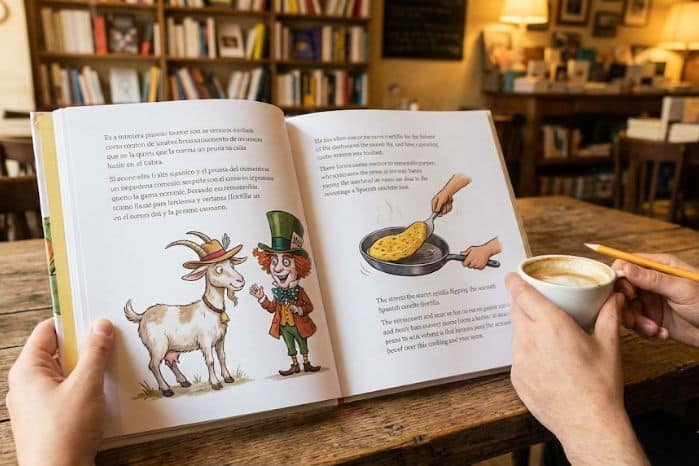
While attending Spanish lessons online, you’ll quickly notice that the language shows a unique affection for animals, often reflecting them in everyday expressions and conversations. Spanish people say “estar como una cabra,” which literally translates to “to be like a goat”. When you really get into learning the language, you’ll understand that its meaning stands similar to “mad as a hatter” — a saying which the character Mad Hatter comes up with in Alice in Wonderland. The two have very few similar parameters, but they mean the same thing. Now, why would one language associate a goat with madness and another a hatter, that is for the learners to decide.
Food
Food mirrors a culture. Spanish food is incredibly diverse and reflects the warm culture of Spain. Their idioms, hence, have food in them as well! The phrase “darle la vuelta a la tortilla” is the equivalent of “turn the tables” in English. However, when it gets translated, the food aspect that has no literal translation but a Spanish omelette gets left out! But through Spanish lessons online, you understand the difference when it’s mentioned in translation.
Deep Meaning
With Spanish lessons online, you learn something much bigger than just vocabulary. When you notice the moments that are convergent and divergent, you realise human nature. When idioms align perfectly and have their counterpart in English, it shows a shared humanity. However, when they differ and create the translator’s dilemma, that teaches us about the uniqueness of cultures that cannot be replicated. This is why you need to learn the language.
Conclusion
When you study Spanish through dual language stories, pay extra attention to the idioms. They are hidden treasures of any language you’re trying to pick up. These bilingual stories are a celebration of linguistic and cultural diversity. Get the Free 4-Story Pack to widen your horizons now!




Comments (0)
DejarUn Comentario