



Why Native Spanish Sounds Faster Than What You Learned
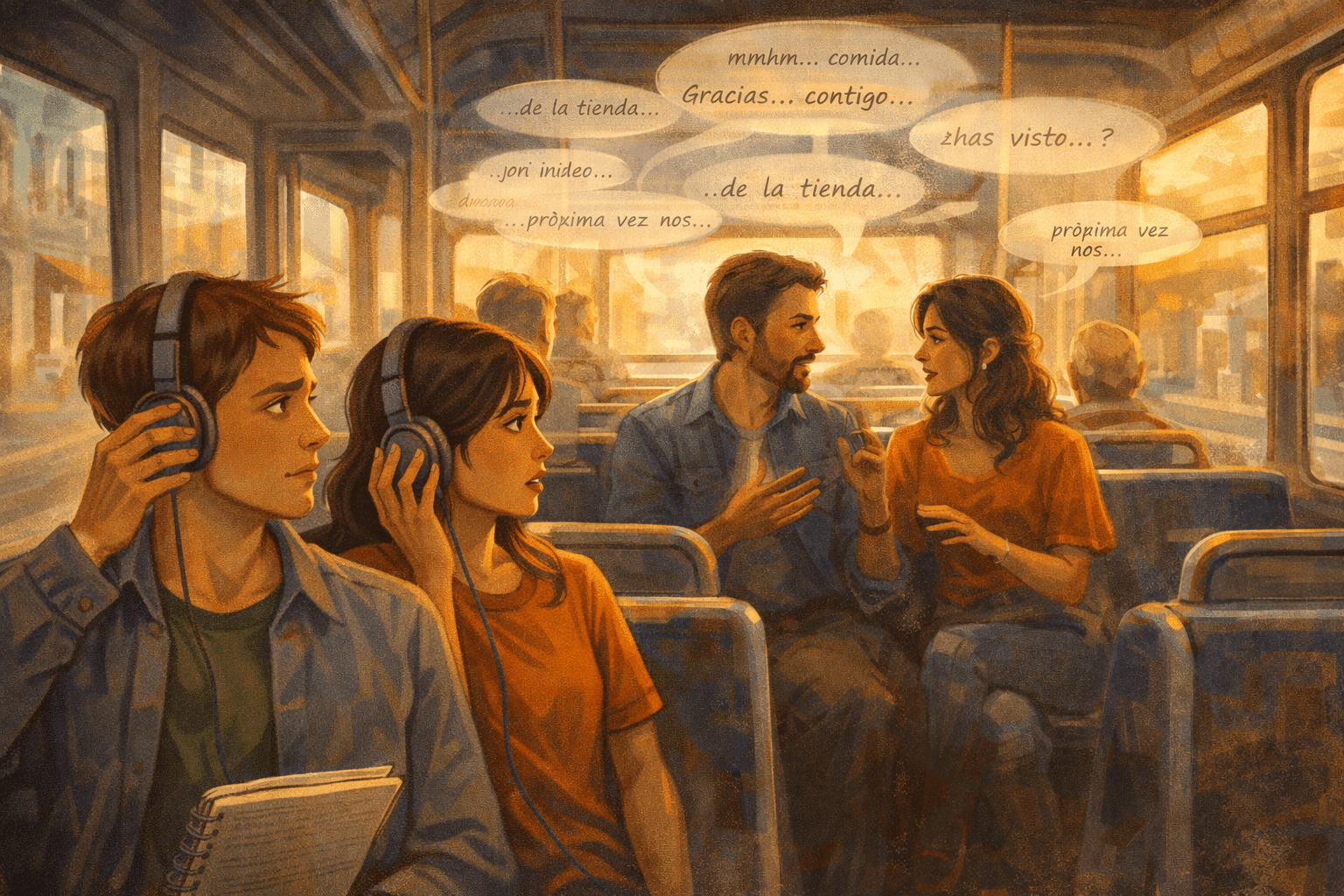
Many learners reach a confusing moment in their Spanish journey.
You understand your lessons.
You follow slow conversations.
You can read comfortably and even recognize familiar phrases when spoken clearly.
But then you hear native Spanish in real life — and suddenly everything feels impossibly fast.
Words blur together.
You miss the beginning of sentences.
By the time you process one phrase, the speaker is already two thoughts ahead.
It can feel discouraging, like all your learning disappears the moment real speech begins.
But here’s the reassuring truth:
Native Spanish isn’t actually faster than what you learned.
It’s simply more connected, more rhythmic, and less separated than classroom Spanish.
And once you understand why, listening starts to feel far less overwhelming.
The Difference Between Learning Spanish and Hearing Spanish
Most learning materials present Spanish in a clear, carefully separated way. Words are pronounced fully, pauses are generous, and sentences are delivered with the learner in mind.
That clarity is helpful at first.
But real Spanish doesn’t pause between words the way lessons do. Native speakers naturally connect sounds, reduce certain syllables, and rely heavily on rhythm rather than individual word boundaries.
Your brain expects to hear:
- distinct words
- predictable pauses
- fully pronounced endings
Instead, you hear a flowing stream of sound.
This mismatch creates the illusion of speed.
It’s not that speakers are talking too fast — it’s that your brain hasn’t yet adjusted to how Spanish naturally moves.
Rhythm Matters More Than Speed
Spanish is a rhythm-driven language. Stress patterns, vowel flow, and syllable timing shape how speech is perceived more than the speed of individual words.
Native speakers glide through phrases by linking sounds together. Small words soften, syllables blend, and familiar expressions compress into smooth sound patterns.
For learners, this can feel like entire words disappear.
But they’re not disappearing — they’re blending.
This is why many learners who try to learn Spanish by listening to audio initially feel frustrated. Without context, connected speech can sound unpredictable. Your brain is trying to decode individual words when it actually needs to recognize sound patterns.
And pattern recognition takes exposure.
The Hidden Role of Sound Reduction and Connection
Two things make native Spanish especially challenging for learners:
Reduction:
Certain syllables soften or shorten in natural speech, especially in common phrases.
Connection:
Words don’t sit next to each other — they flow into one another. The end of one word often merges with the beginning of the next.
These features make speech feel continuous rather than segmented.
But here’s the encouraging part: your brain adapts quickly once it hears these patterns repeatedly in a meaningful context.
This is where audio Spanish lessons that include narrative structure become incredibly helpful. Stories provide predictable context, emotional cues, and repeated phrasing — all of which make connected speech easier to anticipate.
Instead of trying to decode isolated sounds, you begin to recognize familiar rhythms.
Why Stories Make Listening Feel Slower
One of the most effective ways to retrain listening expectations is through Spanish audio stories.
Stories naturally slow the experience of listening, even when the speech is authentic. Because you understand the setting, the characters, and the emotional direction, your brain doesn’t need to process every word individually.
You’re listening for meaning, not perfection.
This shift reduces anxiety and allows recognition to grow organically. Familiar phrases begin to stand out. Connected speech becomes less intimidating. And over time, native pacing starts to feel more comfortable.
If you’ve explored the Stories page, you may have noticed how repeated listening to narrative audio creates familiarity with rhythm rather than just vocabulary. The more often you hear phrases within the same story context, the easier it becomes to anticipate how Spanish flows.
Listening doesn’t feel faster — it feels more recognizable.
Why Safe Listening Environments Matter
Many learners try to jump directly into fast podcasts, films, or street conversations and feel overwhelmed.
The problem isn’t effort — it’s the lack of a supportive listening environment.
When audio is completely unfamiliar, your brain works harder to interpret both meaning and sound at the same time. That cognitive load can make native Spanish feel exhausting instead of engaging.
A safer listening experience includes:
- clear but natural pacing
- contextual support
- repetition opportunities
- emotional familiarity
This is why structured audio exposure can dramatically change listening confidence. When you feel safe missing a few words without losing the story, your brain relaxes — and relaxed listening leads to faster adaptation.
If you’re looking for a gentle way to rebuild listening comfort, the Free 4-Story Pack offers a space where you can hear natural Spanish without the pressure of keeping up perfectly. That sense of familiarity often makes native rhythm feel less intimidating over time.
Listening Is a Skill of Familiarity, Not Speed
One of the most reassuring realizations in language learning is that listening comprehension doesn’t improve because speakers slow down.
It improves because your brain becomes familiar with how the language sounds when it’s connected.
The moment Spanish stops feeling like individual words and starts feeling like recognizable sound patterns, native speech suddenly feels more accessible.
That transition doesn’t happen through forcing comprehension. It happens through repeated exposure, emotional context, and patience with the listening process.
If native Spanish currently feels too fast, it doesn’t mean you’re behind.
It means your ears are still adjusting.
And just like vocabulary and reading fluency, listening confidence grows quietly before you notice it. The more often you hear Spanish in meaningful, story-driven environments, the more natural its rhythm becomes.
Eventually, what once sounded overwhelming begins to sound familiar.
Not because the language changed — but because your listening did.

Comments (0)
DejarUn Comentario